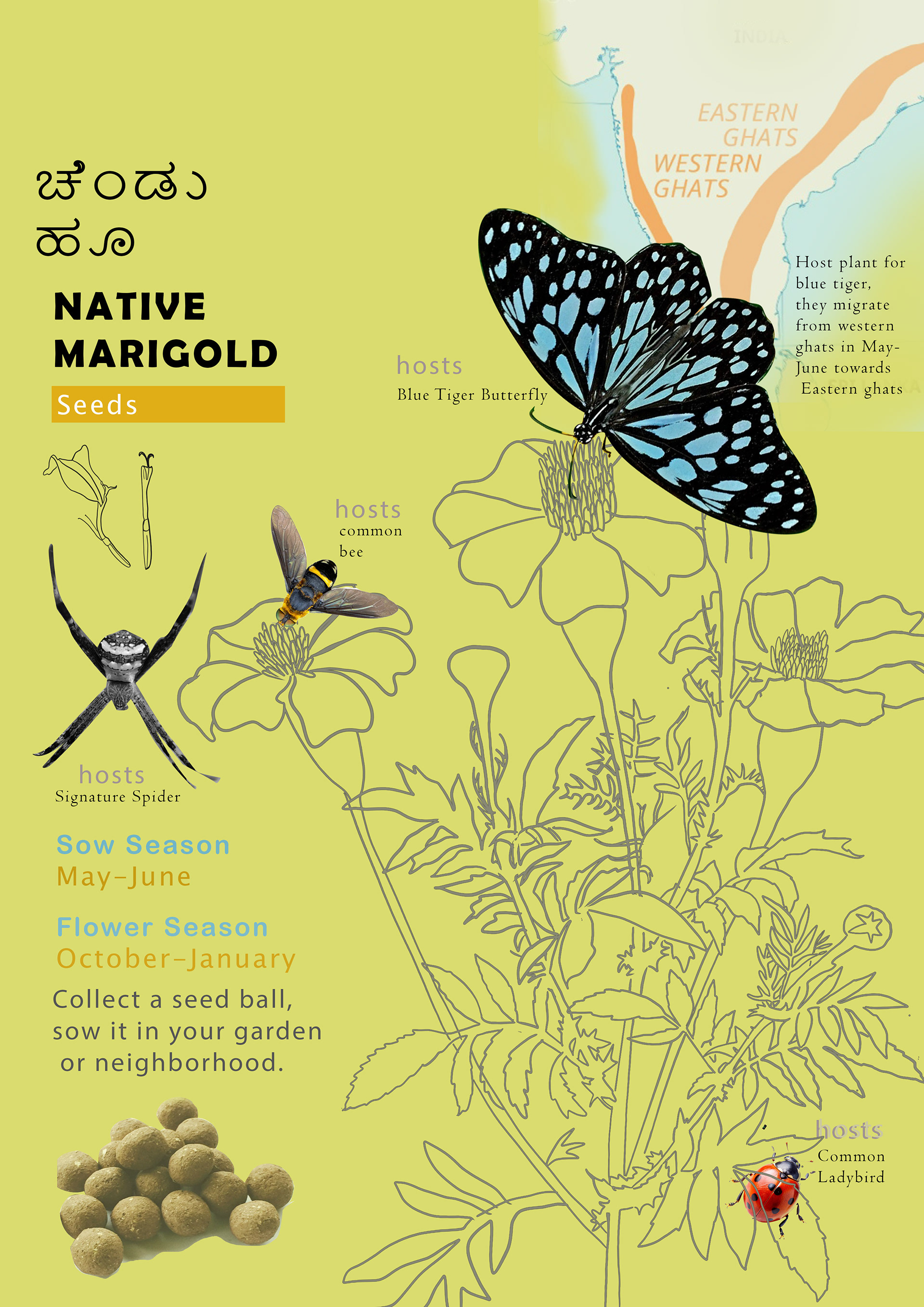
Gifting seeds can be the most humbling act. When a dear friend gifted me with a flowering seed last Year in June, I promptly sowed them in a bed on my terrace.
The seeds were a prompt for a response, but it became a gesture that I could multiply and cultivate manyfold. It was a way to experience nature's abundance. I recieved very hardy variety of marigold seeds ( nati or Native) that had many unique qualities. Easy to grow, resistant to pests, it invites a host of insects and friendly bugs that keep many pests away.
Signature spider found a constant home. I was fascinated by its presence and patience. I recognised that the pest in the nearby pots had reduced. I got a better yield of flowers. Many other insects followed untill one day I noticed the butterfly. The blue tiger, as it's known, came in hordes as they were migrating and made a stopover in Bangalore. It was a sight to behold. The bright yellow flowering marigold contrasts with the blue butterflies
Marigold is a member of the Tagates family. Although they are not really native to India and have come via Mexico. Marigold is a big part of our floral culture and a representative for religious and non religious ceromonies like weddings.
More about Marigold
It is a herbaceous annual or perennial plant, with heights ranging from 30 to 110 cm. The root is cylindrical, pivoting, with a fibrous and shallow branching system. The stem is striated, sometimes ridged, smooth or slightly with villi, cylindrical, oval and herbaceous to slightly woody, with resin channels in the bark, which are aromatic when squeezed. Opposite leaves at the bottom alternate at the top, up to 20 cm long, pinnate, composed of 11 to 17 leaflets, lanceolate to linear-lanceolate, up to 5 cm long and 1.5 cm wide, acute to acuminate, serrated to sub-holders, the lower ones of each leaf frequently setiform (in the form of threads), the superiors are sometimes completely setiform; with abundant round glands.
The main characteristic of the flowers is that they are grouped in small heads or in solitary inflorescences, on peduncles up to 15 cm long, and they are liguladas of yellow to red colours. In the flowers of the disc: 150 to 250 in the simple heads, in the doubles, it shows different degrees of transformation in ligules, yellow to orange corollas, of 8 to 10 mm in length. The fruits and seeds are: linear achenes 7 to 10 mm long, smooth or slightly covered with stiff hairs at the corners. It has a long flowering period extending throughout the summer and fall. It reproduces easily by seed.[16]
Distribution and Habitat
Although native to Mexico, they are also found in the countries of Central America and the Caribbean: Belize, Bolivia, Colombia, Costa Rica, Cuba, Ecuador, El Salvador, Guatemala, Guyana, Honduras, Jamaica, Nicaragua, Panama, Puerto Rico, and Venezuela.[17]
In their wild form they are found in the Balsas basin and western Mexico and live in diverse types of ecosystems, such as tropical deciduous forests, thorny forests, cloud forests and pine-oak forests. In the wild, it is found as a getaway in heavily disturbed places at altitudes of 800–2300 m.[18]
As an introduced species (cultivated) it can be found in China, India, Zambia, Zimbabwe, South Africa and Australia.